
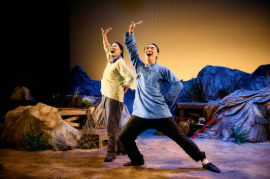

Tony-winning playwright David Henry Hwang combines fact, fiction, and Chinese Opera in The Dance And The Railroad, a strikingly acted, designed, and danced Artists At Play and Latino Theater Company revival of Hwang’s poignant 1981 one-act.
What’s factual is the 1867 Transcontinental Railroad Strike, during which around 3,000 Chinese railroad laborers refused to return to work until their demands for higher pay and shorter hours were met.
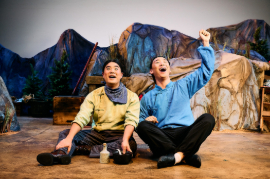
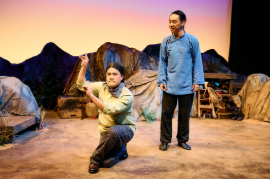 What’s fictional are The Dance And The Railroad’s two railroad worker protagonists, the more experienced 20-year-old Lone (Tony Jin), who spends his limited downtime atop Gold Mountain honing stylized, symbolic, athletic dance moves so characteristic of Chinese Opera, and his naïve, fresh-off-the-boat 18-year-old would-be protégé Ma (Scott Keiji Takeda).
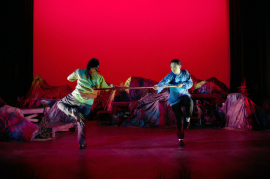 And finally, what’s Chinese Opera about Hwang’s 60-minute play is its final third, during which Lone and Ma improvise a dance opus inspired by the latter’s journey to America and the life he believes lies ahead of him.
But I’m getting ahead of myself.
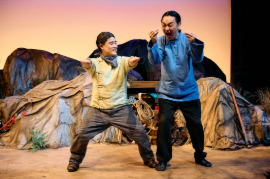 Let’s start at the very beginning, when Ma first climbs the mountain in hopes of receiving instruction from the only slightly older but considerably more experienced Chinese Opera master, who perhaps not surprisingly scoffs at the younger man’s request.
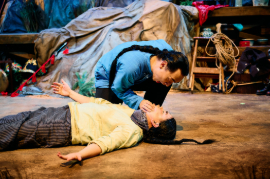 How, declares Lone, can Ma hope to master, or even begin to execute moves that the former has spent a lifetime learning, particularly given that railroad labor takes up most of Ma’s day, though hopefully not for long if the striking laborers’ demands for an 8-hour work and a $14-a-week raise are met.
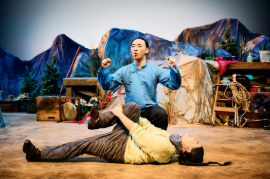 Not that Ma’s naïveté is restricted to his plan to become a Chinese Opera pro in a matter of months. (He has also swallowed everything his fellow workers have told him about “about the mild winters and the warm snow” he can expect in the months to come.)
Still, with a teenager as persistent as Ma begging for lessons, what can a reasonable man do but agree to mentor him, though before Ma can learn to run or even walk, he must learn to crawl, even if that means maintaining a locust’s crouched posture throughout the entire night, leg cramps be damned.
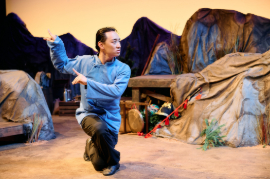 The Dance And The Railroad succeeds as early David Henry Hwang (the future writer of M Butterfly, Yellow Face, and Chinglish was only 23 when it was first produced) for its look back at early Chinese-American history, for the two fascinating, diametrically different characters he has created and the reluctant friendship that develops between them, and for its Chinese Opera dance moves, not only those that Lone demonstrates (and Ma attempts) early on in the play but in the stunning improvised opera the two create in its final third.
L.A. theater favorite Takeda and exciting newcomer Jin command the stage under Katherine Chou’s flawless direction as two couldn’t-be-more-different protagonists.
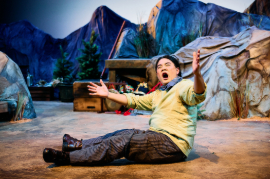 Takeda is an absolute delight as the eager-to-learn but ever so gullible Ma and Jin (who went from understudy to lead just two weeks before opening night) is a revelation as the proud, aloof, gifted Lone, a case of two absolute opposites attracting the audience’s rapt attention despite dialog that can come across a tad simplistic compared to Hwang’s later plays.
The Dance And The Railroad is a visual stunner too, showcasing the prodigious gifts of an all-Asian design team composed of Leah Ramillano (set), JoJo Siu (costumes), Szu-Yun Wang (lighting), Naomi Kasahara (properties), and Sherry Aporongao Younge (hair and makeup).
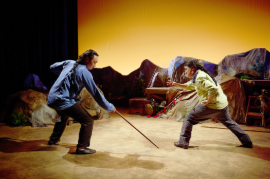 Not only that, but Jesse Mandapat’s sound design provides an atmospheric musical accompaniment to choreographer Annie Yee’s magical Chinese Opera-inspired dance moves.
Kosi Eguchi and Louis Ng understudy the roles of Ma and Lone. Nico Pang is associate director and dramaturg. Diana Gomez is associate costume designer. Brandon Hong Cheng is production stage manager and Evelyn Pham is assistant stage manager. Lucy Pollak is publicist.
 The general American public may be slightly aware of the participation of Chinese workers in building the Transcontinental Railroad, but I’m guessing that few if any have heard of the 1867 Railroad Strike, just one reason The Dance And The Railroad deserves to be seen. That it raises our consciousness with as much vibrancy as historical accuracy only adds to its appeal.
Los Angeles Theatre Center, 514 S. Spring St., Los Angeles. Through November 1. Thursday, Friday, and Saturday at 8:00. Sundays at 4:00.
www.latinotheaterco.org
–Steven Stanley
October 3, 2026
Photos: Michael Palma
Visit www.theatreinla.com/nowplayingrs.php for a review roundup of what’s now playing in theaters around Los Angeles.
Tags: Artists At Play, David Henry Hwang, Los Angeles Theater Review, The Latino Theater Company

 Since 2007, Steven Stanley's StageSceneLA.com has spotlighted the best in Southern California theater via reviews, interviews, and its annual StageSceneLA Scenies.






 COPYRIGHT 2026 STEVEN STANLEY :: DESIGN BY