

A hundred million miracles may be happening every day, but none are more miraculous where musical theater is concerned than the one that has transformed Flower Drum Song, splendiferously revived at Little Tokyo’s Aratani Theatre, from a show filled with antiquated stereotypes to one that can now take its place among Rodgers and Hammerstein’s finest.
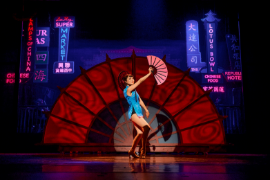 It’s not that the 1958 Broadway original wasn’t groundbreaking. (It did, after all, feature an almost entirely Asian cast playing characters whose lives intersected in San Francisco’s Chinatown.)
But stand the test of time Flower Drum Song did not, which may explain why the Rodgers and Hammerstein estate did something it had never done before by allowing Tony-winning playwright David Henry Hwang to breathe new life into an old chestnut with a total rewrite of the musical’s creaky book*.
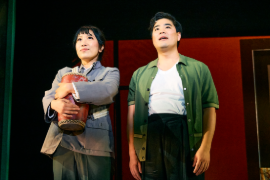 No longer a Chinese mail-order bride, the Mei-li whom Mark Taper Forum audiences became reacquainted with in 2001 was now a refuge from Communist China. Immigrant patriarch Wang now ran a struggling Chinese Opera company transformed once a week by his adult son Ta into a far better attended nightclub starring leggy singer-dancer Linda Low, and Madame Liang was reconceived from gossipy “auntie” into an ambitious Chinese businesswoman.
Left on the cutting room floor were unrequited love victim Helen Chao, sassy Americanized teen Wang San, and (at least as a separate character) nightclub impresario Sammy Fong.
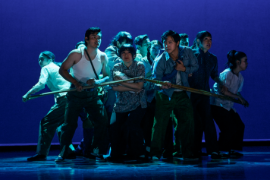 Hwang’s rewrite gave Flower Drum Song (now a celebration of the immigrant experience, an examination of what it means to be both Asian and American, and a more serious look at first-and-second-generation conflicts) a gravitas it had previously lacked without abandoning its musical comedy roots.
On the minus side, in ridding Flower Drum Song of its offensive Asian-American stereotypes, Hwang ended up introducing a brand-new stereotype of his own in the person of Ta’s flouncing gay assistant Harvard.
But that was then, and the year 2026 has gifted audiences with a freshly revised revisal that not only gives Harvard a much-needed makeover but no longer feels like 2nd-tier R&H.
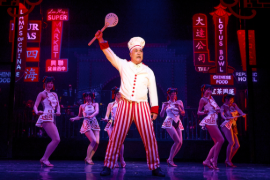 Most of the original 1958 songs remain, among them the much-covered “I Enjoy Being A Girl,” the charming “Sunday,” the uber-catchy “Grant Avenue,” the saucy “Fan Tan Fannie,” the delightful “Don’t Marry Me,” and the exquisite “You Are Beautiful,” some of them sung by different characters than those who performed them in the Broadway original. (Mei-Li, for example, now gets arguably the most drop-dead gorgeous of them all, the heartbreaking “Love, Look Away.”)
And all of this has come together to captivating effect on the Aratani Theatre stage as East West Players artistic director Lily Tung Crystal directs an all-around sensational cast with sensitivity and flair.
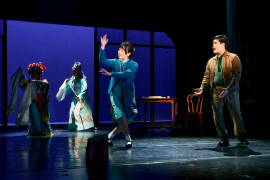 Grace Yoo’s star turn as Mei-Li is as exquisite as her vocals are rich and Scott Keiji Takeda (Ta) proves himself a musical theater leading man/tenor to be reckoned with.
Original Revival Cast member Marc Oka and East West Players legend Emily Kuroda are non-stop delights as Wang and Madame Liang, and never more so than when a rechristened “Sammy Fong” and the bold-and-brassy Madame duet “Don’t Marry Me.”
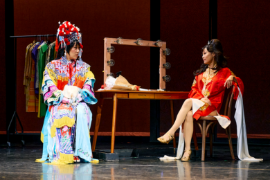 Krista Marie Yu gives screen goddess Nancy Kwan a run for her money as a simply scrumdiddlyumptious Linda, the always delightful Gedde Watanabe embodies avuncular wisdom as the advice-giving Chin, and Cooper Lee Bennett exudes so much sex appeal as Mei-Li’s fellow refugee Chan, I’d be worried if I were Ta.
Last but not least, my USC discovery Kenton Chen takes a character I couldn’t bear back in 2001 and transforms Harvard into a celebration of everything that’s fabulous about being queer, kudos shared with book writer Hwang for giving both Harvard’s storyline and this 2026 revival the most celebratory of grand finales.
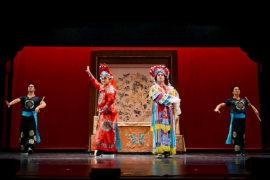 Janelle Dote Portman’s choreography features one show-stopping dance move after another (“Fan Tan Fanny” in particular is Fan Tan Fantastic), and what a song-and-dance ensemble she’s got to work with in the persons of Joven Calloway, IJay Espinoza, Sally Hong, Esther Lee, Brian Liebson, Emma Park, Gemma Pedersen, Hillary Tung, Ai Toyoshima, Haoyi Wen, and Paul Wong, all of whom harmonize to perfection under music director-conductor Marc Macalintal’s expert guidance. (A round of applause to too to Beijing Opera choreographer Jamie Guan.)
Finally, an all-Asian design team (scenic designer Chen-Wei Liao, lighting designer Jiyoun Chang, costume designer Ruoxuan Li, sound designer Brian Hsieh, properties designer Naomi Kasahara, and hair and makeup designer Y. Sharon Peng) fill the Broadway-proportioned Aritani stage with a dazzlingly colorful production design.
Ethan Yaheen-Moy Chan, Sierra Goria, and Tony Jin are ensemble swings.
Mara Palma is assistant director and directing fellow, Annie Jin Wang is dramaturg, Shinshin Yuder Tsai is intimacy coordinator, and Patrick Chew is cultural and language consultant.
Darlene Miyakawa is production stage manager and Brandon Hong Cheng, Jaclyn Gehringer, and Bonifacia-Erlinda Montano are assistant stage managers.
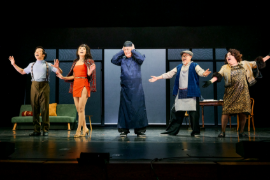 If only for its Rodgers and Hammerstein score, Flower Drum Song deserved a far better fate than to be left collecting dust on the shelf for decades, and its 2002 Broadway revival went a long way towards giving it its rightful place in the R-&-H oeuvre.
Ingeniously tweaked by David Henry Hwang for a new generation of theatergoers, Flower Drum Song may still not reach the heights of Oklahoma!, Carousel, South Pacific, The King And I, and The Sound Of Music, but more than ever before, it comes pretty darned close.
*Original book by Oscar Hammerstein II and Joseph Fields, based on the novel by C.Y. Lee
East West Players, JACCC’s Aratani Theatre at 244 S. San Pedro Street, Los Angeles, CA 90012.
www.eastwestplayers.org
–Steven Stanley
April 23, 2026
Photos: Mike Palma
Visit www.theatreinla.com/nowplayingrs.php for a review roundup of what’s now playing in theaters around Los Angeles.
Tags: David Henry Hwang, East West Players, Japanese American Cultural & Community Center, Los Angeles Theater Review, Rodgers & Hammerstein
 Since 2007, Steven Stanley's StageSceneLA.com has spotlighted the best in Southern California theater via reviews, interviews, and its annual StageSceneLA Scenies.





 COPYRIGHT 2026 STEVEN STANLEY :: DESIGN BY