
An intriguing truth-is-stranger-than-fiction premise (Stalin-era Soviets’ recruitment of African-American performers for a movie expose on racism in the U.S. to be shot in the USSR) and some inventively stylized staging by director Bernadette Speakes are two major pluses in Kimba Henderson’s Red Harlem. What it needs to achieve full impact is a trim.
The year is 1932, the Great Depression grips America, President Hoover’s actions seem only to be exacerbating it, and Blacks like aspiring actress Lenore (Rama Orleans-Lindsay) are hawking the Daily Worker on the streets of Harlem and supporting the Communist Party of America in the coming presidential elections, not the least because an African American, James W. Ford (Micah Johnson, who doubles as political scientist/diplomat Ralph Bunche) is Communist Party USA’s candidate for vice-president.
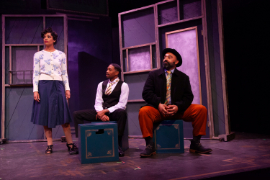 Not nearly as impressed with the Reds is the aptly named Shifty (Luis Kelly-Duarte), for whom Prohibition has meant a profitable business selling “hooch” to Harlem clubs like Smalls Paradise.
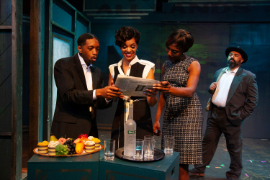 Equally unimpressed are department store elevator operator (and Broadway hopeful) Will (Ahkei Togun) and Cotton Club dancer Selena (Fana Minea Tesfagiorgis), that is until Soviet emigree Misha (Claudio Parrone Jr.) offers the four Harlemites the opportunity to audition for what he promises will be a major motion picture.
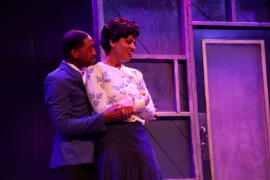 The only catch is that Black and White is going to be shot in Russia, but then again who wouldn’t jump at the chance to, as Selena puts it, “sail on a fine ship all the way to a foreign land” like Josephine Baker did on her way to becoming the toast of Europe.
And given that it was vice-presidential candidate Ford who convinced Stalin to fund the movie, Lenore too is on board with the project, and so is Will given how few roles there are on Broadway for Black actors like himself.
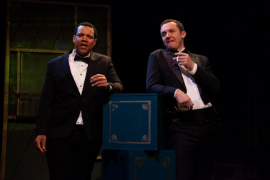 Also along for the voyage is Jewish-American entrepreneur James Tate (Christopher Cassarino), nee Geller, who’ll be stopping off in Berlin to buy a highly profitable nightclub in the Nollendorfplatz where queer entertainers like the gender-bending Velma (Dylan Jones) are the toast of the town.
 Indeed, the only potential fly in the ointment is powerful American-Russian Chamber of Commerce head Hugh Cooper (Dennis Gersten), who expresses concerns that an “anti-American” film like Black And White might have negative consequences on his business ventures in the USSR, the latest of which is the construction of the world’s largest hydroelectric power plant in Soviet Ukraine.
All of this adds up to a two-act drama whose fact-based subject matter alone makes it worth a look-see.
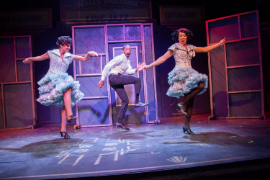
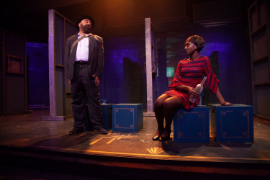 So do the surreal touches of Speakes’ imaginative staging, Justin Huen’s ingeniously conceived scenic design (one that utilizes moving panels and is enhanced by Emmanuel J. Munda’s mix of scene-setting projections and historical black-and-white photography), and Kenya Clay’s Cotton Club-ready choreography.
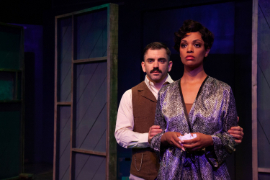 Not only that, but I found Red Harlem’s depiction of colorism in the Black community (the darker-skinned Lenore bemoans the fact that only “Copper Colored Gals” like Selena can perform at the Cotton Club) one well worth its inclusion in Henderson’s script.
 Performances from an all-around topnotch cast could not be finer, in particular the one delivered by a scene-stealing Kelly-Duarte, in portrayals that are both authentic to the era and still relevant in 2026.
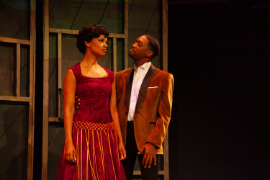 That’s not to say that Henderson’s script couldn’t benefit from some tweaking. How is it, for example, that David, who we know is Jewish, could have a sister dancing at the Cotton Club? And what exactly is it that shocks Lenore and Will to the core on a train ride through the Soviet Ukraine? (Neither Henderson’s script nor Munda’s projections make that sufficiently clear.)
 More significantly, if I found my interest lagging around the 90-minute mark, it wasn’t because of performances or subject matter but because Red Harlem would be so much more effective if twenty-or-so minutes had been left on the cutting-room floor. (The extended nightclub scene in Berlin I found particularly slow-going given that the musical Cabaret has already covered that territory quite satisfactorily indeed.)
Finally, while Huen’s lighting, Jose Medrano Velazquez’s sound design, and Dana Schwartz’s props are all first-rate, what’s up with Mylette Nora’s costuming of early-1930s women in knee-length dresses that look to be from the mid-1960s?
 The World Premiere of Red Harlem is produced for Company Of Angels by Armando Molina, Nakasha Norwood, and Lui Sanchez. Rune Valblaine appears briefly in a mostly wordless cameos. Jennie Webb is dramaturg. Joe DeMichelle is intimacy director.
Kallisto Teng is stage manager and Zelda Castillo is assistant stage manager.
 I’m a big fan of theater that not only entertains but informs as well. Red Harlem does both, so much so that one of the first things I did upon arriving home was to google the names, places, and events I’d just seen depicted on stage. That being said, this is a case where less would have added up to more.
Company Of Angels, 1350 San Pablo Street, Los Angeles.
www.companyofangels.org
–Steven Stanley
February 22, 2026
Photos: Rafael Cardenas
Visit www.theatreinla.com/nowplayingrs.php for a review roundup of what’s now playing in theaters around Los Angeles.
Tags: Company Of Angels, Kimba Henderson, Los Angeles Theater Review
 Since 2007, Steven Stanley's StageSceneLA.com has spotlighted the best in Southern California theater via reviews, interviews, and its annual StageSceneLA Scenies.






 COPYRIGHT 2026 STEVEN STANLEY :: DESIGN BY